

EU opts for blockchain
Is the ECB's blockchain-centric strategy correct?

Key insights in this post
The European Central Bank (ECB) released a comprehensive payments strategy that goes heavy on distributed ledger technology, i.e., Blockchain
The strategy outlines four aims, 2 each around efficiency and autonomy:
Efficiency
… ensure the effectiveness of monetary policy, financial stability and the smooth functioning of payment systems …
… foster an integrated, competitive and innovative payments ecosystem
Autonomy
… achieve strategic autonomy and increased resilience for European payments
.. support the international role of the euro
The strategy clusters initiatives around 5 use cases
Domestic settlement: Developing a European market for tokenised settlement assets
Wholesale: Improving the existing infrastructure and investing in distributed ledger technology (DLT)-based solutions for wholesale payments
Corporate: Enhancing standardisation, automation and process integration in corporate payments
Retail: Achieving resilient, integrated, innovative and competitive euro retail payments through the digital euro and market-led solutions
Cross-border: Advancing the G20 roadmap to enhance cross-border payment
Domestic Settlement. This largely calls for interoperability among Euro-based digital currencies like Stablecoins, Tokenized Deposits & CBDCs
Wholesale. This inserts a CBDC as the preferred method for ultimate settlement of Euro-based DCs. They effectively want to re-centralize what is by design a decentralized ecosystem
Corporate. This acknowledges that the Instant system (TIPS) already satisfies this use case. Most of the recommendations are for improvement of corporate-side ERPs to improve straight-through processing
Retail. This section anticipates a domestic use of DCs to displace the global card networks. They largely expect CBDCs to assume the central role, alongside Stablecoins and Tokenized Deposits.
Cross-border. Rather than use a DLT solution here, which is already global, they recommend linking national Instant systems to TIPS, one-by-one. This seems odd when the best use case for DLT methods is cross-border
Conclusions
The ECB strategy favors DLT solutions domestically and Instant solutions for cross-border. I think this is generally backwards.
Cross-border: Blockchains are colonizing cross-border use cases faster than domestic uses cases. The ECB strategy seemingly wants to unwind this
Domestic: DLTs add almost no incremental value versus instant systems. Instant is low-cost, real-time, irrevocable, and ubiquitous. It carries ISO 20022 data. The only real incremental value of DLTs are smart contracts, but these have been slow to emerge in mass market domestic use cases
Wholesale: CBDCs are a better way for Central Banks to transact with each other and, perhaps with commercial banks. Beyond those use cases they risk crowding out consumer deposits and therefore contracting private sector credit
The ECB admirably pursued this effort but, unsurprisingly, doesn’t fully deliver on its aims. No one knows where all this is headed, but directionally I expect DLT to capture cross-border while Instant captures domestic. This will all take a very long time to play out
Introduction
The European Central Bank (ECB) released a comprehensive payments strategy that goes heavy on distributed ledger technology, i.e., Blockchain:
“The Eurosystem’s approach is two-pronged: improving the existing payment infrastructures at the same time as catalysing and supporting new ones. This approach is based on four strategic aims:
(i) to ensure the effectiveness of monetary policy, financial stability and the smooth functioning of payment systems by maintaining the role of central bank money as the anchor of a two-tier monetary system,
(ii) to achieve strategic autonomy and increased resilience for European payments,
(iii) to foster an integrated, competitive and innovative payments ecosystem, and
(iv) to support the international role of the euro.”
In contrast to the U.S. where the private sector leads the way on payments, the EU has always been more interventionist. They need to integrate sub-scale payments “islands” in each country into a union-wide whole.
They face an ecosystem where the US-centric card networks dominate that payment method, with limited European input. The increasing use of US sanctions policy, enforced via those networks, is a global concern, but resonates strongly in the EU. They want the Euro to have similar stature to the dollar in global finance; so far, with mixed success.
Dollar-dominance extends to Digital Currency as Stablecoins generally focus on USD:
Circle, a US company, has both USDC and EURC. Gemini tells me that USDC has current circulation worth $77B while EURC is at $400M
Tether, has European roots, but is now based in El Salvador. It sunset its Euro stablecoin late last year. It has introduced a replacement (EURQ) with a total circulation today of <€5M. Tether’s USDT coin leads the market at ~$185B.
Even Europeans seem to use USD stablecoins for crypto trading.
This post will wade through the details of the Comprehensive Strategy so you don’t have to!
My priors
I have written many Stablecoin posts. Bear in mind that I bring my biases to this commentary. For convenience, I list my key biases here:
Blockchains will be the future technology base for payments networks
They are more resilient and have lower fixed costs than “central-switch” networks
They have no central authority setting the rules, acting in its own interest and collecting tolls. Instead, rules are by consensus and encoded in software
This future is a long way out
Incumbent methods work well, have near universal acceptance and have inertia on their side
ACH is cheap and universal, but it is not real time and can have fraud and returns problems as a result. ACH does not usually work cross-border
Instant does almost everything a blockchain does. Both are real-time, push-only, and low cost. Instant is nearly universal domestically, but doesn’t yet work cross-border
Cards provide strong consumer protection. Credit cards provide 30-days float, credit, and, in the US, rewards. However, those benefits come with high acceptance costs. Cards are cross-border via the global V/MC networks
Blockchains have some functional advantages over instant in edge use cases
Blockchains work well cross-border while instant and ACH usually serve one country or region
Blockchains have smart contracts (“programmable money”) while instant systems are pure money movement
Blockchain currencies are infinitely divisible for use in micropayments. Instant systems’ higher fixed costs price them out of micropayments
A major secondary impact of widespread Stablecoin adoption is their crowding out affect on private sector credit
In most cases, stablecoin reserves are invested in government securities
If stablecoins displace bank-centric payment methods, banks will have less deposits to lend out. That will raise APRs and restrict credit
Restricting Stablecoins from paying yield reduces this problem
CBDCs are DLT-based, but rely on bank reserves held at the Central Bank not government securities; they may or may not crowd out private credit
Tokenized deposits provide all the DLT benefits of Stablecoins while leaving private sector deposits at the core of finance
The conclusion from all that is that Blockchain payments work best in cross-border use cases where the incumbent is the antiquated Correspondent Banking System; DLT payment methods don’t add much value yet for domestic uses cases when compared to Instant. Wide-spread adoption of Smart Contracts would change that calculus, but few mass market use cases for Smart Contracts have emerged to date.
The EU Strategy
Here is the EU’s graphical view of their aims:
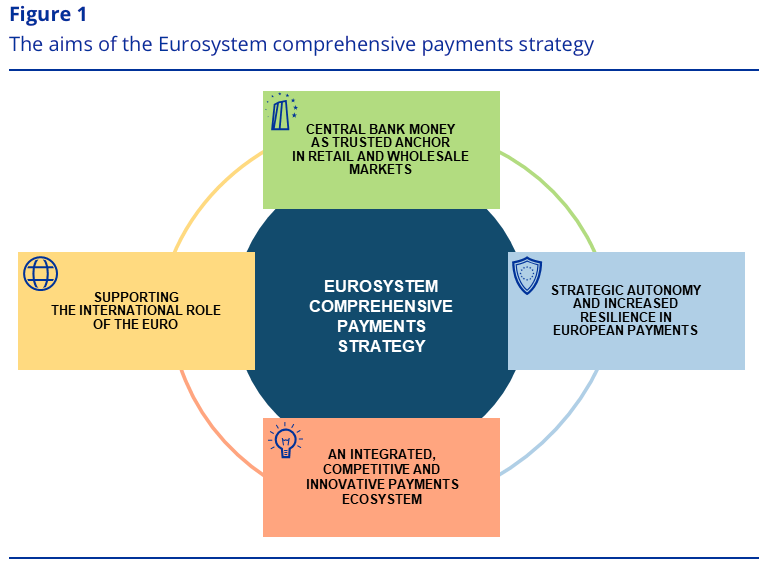
Admirably straightforward! Two aims of the EU strategy are about Euro relevance in global finance: To achieve strategy autonomy and to support the international role of the Euro.
A novelty of the EU strategy is the importance of “Central Bank Money”, otherwise known as Central Bank Digital Currency (CBDC). The US has considered a CBDC but rejected it in favor of private sector initiatives – at least partially out of concern that a CBDC might drain deposits from the banking system.
The final aim: A “Competitive payments ecosystem” was exactly what every central bank claimed for their Instant initiatives within the last 10 years. Having led the world in Instant adoption, is the EU leaving it in their rear-view mirror and shifting over to DLT? If so, why? Both payment methods are fully digital, instant, irrevocable, low-cost, and information rich. DLT is also programmable (i.e., smart contracts) but few use cases take advantage of that so far. As I read the strategy, I was looking for the vision for why a Euro Stablecoin is a better domestic payment method than their newish Instant systems.
Tactical initiatives
The strategy outlines five tactical initiatives to achieve the four strategic aims:
Domestic settlement: Developing a European market for tokenised settlement assets
Wholesale: Improving the existing infrastructure and investing in distributed ledger technology (DLT)-based solutions for wholesale payments
Corporate: Enhancing standardisation, automation and process integration in corporate payments
Retail: Achieving resilient, integrated, innovative and competitive euro retail payments through the digital euro and market-led solutions
Cross-border: Advancing the G20 roadmap to enhance cross-border payments
The bolded text above is mine, to distill the topic from the descriptions. What I show in italics is the lead-in sentence to each topic. The document has dense detail in a following paragraph. I spared you from the word-salad.
The distinguishing of Wholesale from Corporate was novel to me. Wholesale addresses financial market use cases while Corporate addresses B2B payments. Both are high ticket use cases. Incumbent methods don’t make the distinction between Financial Market and Corporate use cases as both use Wires (RTGS), ACH, & Instant. To a degree, the US CHIPS system largely serves such Wholesale use cases in parallel with Fedwire.
This section ends with the following cri de guerre:
This strategy will be key in shaping the European payments landscape of tomorrow, supporting competitiveness, innovation and resilience, and delivering tangible benefits for European citizens, businesses and markets.
I will evaluate each of the initiatives relative to this declaration.
Settlement
My key observation here is that they fail to distinguish why a blockchain based payment network improves on the Instant systems they have only recently rolled out. They describe the that benefit of “tokenization”: “transactions occur through programmable platforms that integrate processes traditionally managed separately, such as messaging, reconciliation and settlement”.
Other than the programmable part, Instant systems also integrate messaging, reconciliation and settlement. Every instant transaction can carry an ISO 20022 message packet with all the information needed for reconciliation. Despite that advantage, takeup among corporate users has been spotty. Instant settles … instantly, so are on par with DLT-payments. The only thing instant lacks is programmability, but that has been absent in most use cases to date. It is definitely an attractive feature. Today, the equivalent would be implemented either by payments providers or ERP software providers. So programmability is not entirely absent, just fragmented. It is an open question whether embedding the programmability into the network will lead to higher adoption.
The strategy contemplates an environment where CBDC coexist with Stablecoins and Tokenized deposits. They don’t say it explicitly, but I think what they are calling for is more interoperability among those three methods. A variety of private sector technology companies already provide the infrastructure that facilitates this. For example, this is how Gemini summarizes Fireblocks:
“… enables digital currencies and assets to interoperate across different blockchains, financial institutions, and payment systems. Through the Fireblocks Network for Payments, it connects over 2,400 institutions, linking 120+ blockchains and 60+ currencies”
Is the ECB suggesting the industry develop a standard to make this easier, (i.e., disintermediate Fireblocks et al.) or is the ECB calling for more banks and corporations to adopt Firelocks-like technology? The strategy is unclear. Effectively, the market has solved this problem and they solved it globally, not just for the EU. So what exactly is new in the ECB strategy?
Wholesale
The ECB answers my question in this section:
By facilitating convertibility and interoperability between different forms of tokenised settlement assets, central bank money in tokenised form enhances efficiency across the value chain. Tokenised central bank money also fosters market integration by preventing the development of fragmented silos based on separate private settlement assets.
The ECB asserts that ultimate settlement via its own CBDC is a better way to foster integration that the technology-based solutions that do this today. Effectively they want to re-centralize a by-design decentralized ecosystem.
There may be very good policy reasons for this, and the document mentions control over monetary policy as one of them. But it is hard to get around the idea that the ECB is recommending a strategy that makes the ECB the essential hub of the new regime. We saw this in the US where the Fed decided to build Fednow even though the big banks had already built the near-identical RTP system.
In my view, this is neither necessary nor efficient. All tokenized methods are already prepaid. A stablecoin is based on paid-in fiat that is stored in government issued securities, A tokenized deposit is based on bank deposits sitting on bank balance sheets and insured by a prudential regulator, and CBDCs are based on bank reserves held at the central bank. Since all transactions are push-only and instant, where is the settlement risk?
Will the ECB invest enough money to ensure its system is responsive and resilient? Government agencies are not known for their technological savvy and investment. And how will the ECB system help with cross-border use cases, which may dominate volumes? It seems to solve a domestic settlement challenge which has yet to emerge while ignoring the cross-border challenge which is where all the volume is.
The final point in this section states that the ECB will continue to invest in incumbent payments systems during the transition, including their RTGS and Instant systems. They set no timeline for when the shift to blockchains will occur.
Corporate
Here, there is full acknowledgement of the ECB’s Instant system called TIPS. They even note that TIPS supports non-Euro currencies (e.g., for Sweden & Denmark). They essentially say that the Instant system satisfies all the payments needs already.
What they call out is that corporate-side ERP systems lack some capabilities to take advantage of of Instant payments features. Blockchain based currencies don’t change that. The ECB call for more standardization and suggest the Euro Retail Payments Board (ERPB) as a forum to coordinate that.
But after wading through all the verbiage, they basically acknowledge that blockchain currencies are not a major improvement over Instant until industry takes advantage of the smart contract features. The only comment on this is: “conditional payments for B2B payments were identified as a promising area”. They provide no roadmap to achieve that and no examples where it might help.
Retail
The lead-in to this paragraph gives away the game (bolding is mine):
“Europe’s payments landscape remains fragmented, with many countries relying heavily on non-European providers for digital transactions” … In addition, there is no “home-grown” electronic payment option that covers the entire euro area, despite recent momentum.”
Payments Nationalism rears its head. The ECB’s solution is a Digital Euro based on central bank money, i.e., a CBDC. This is described as “supporting sovereignty” and “strategic autonomy” in retail payments. They are careful to say:
“… the digital euro would preserve the two-tier system of central bank money and commercial bank money, ensuring that banks are not disintermediated and thereby maintaining their key role in financing the euro area economy and in the transmission of monetary policy.”
This envisions the CBDC alongside Euro-stablecoins and Euro-tokenized deposits, but it doesn’t say why a consumer would choose the bank or fintech offerings over the ECB offering.
I read this as assuming the Euro-CBDC would be the backup while the private sector methods would be the primaries. But if all three kinds are fully interoperable, why would consumers not opt for the ECB version? In other words, if the three types have identical functionality, value, security, etc. Why would a consumer choose private over ECB?
Further, they assume the “absence of scheme fees”. Without scheme fees (“gas” fees in blockchain-speak) how will the private sector support investments in acceptance? Acquirers would still charge fees, just like for cards, but those fees would be lower with lower chargeback and fraud risk. Furthermore, acquirers provide connectivity, not governance. The coin issuers benefit from spread income: standard transfer pricing for tokenized deposits and reserves yield for stablecoins, but without scheme fees, who promotes acceptance, interoperability, disputes, etc? The issuers incentive is to hold the balances not spend them.
I am not a fan of card network scheme fees. They are too high and they never fall despite massive reductions in technology cost. They also favor large merchants via volume-based incentive payments while the small merchants pay rack rate. But networks do provide a useful function, so who will do that going forward? I don’t think the ECB has entirely thought that through. After all, the ECB already charges the equivalent of scheme fees for its own payments services.
Further, the strategy spends time outlining the use of Instant payments as an A2A alternative to cards. Instant schemes are already Euro-centric and fully integrated with both the ECB and EU banking system. Since Instant schemes have almost the same functionality as blockchains, why does Europe need both? Inquiring minds want to know.
In summary, I think the ECB knows the outcome it wants in retail payments, but has not fully thought through how to get there. It is rushing down several paths at once and risks fragmenting the market.
Cross-border
This section starts with a focus on Instant systems rather than Blockchain systems – the opposite of all the domestic commentary. The document lists a number of initiatives to link the ECB’s Instant TIPS system to other instant systems globally. Having some insight into similar US initiatives, this is no simple task. Zelle is trying to do the same thing and there were past initiatives to link the TCH RTP system with the UK’s Faster Payments system among other, national instant systems.
This approach surprised me, because cross-border is the killer use case for blockchain-based payments. So far, most Stablecoins retail use cases are cross-border and the main Tokenized Deposit use case is cross-border Treasury Services (Corporate). I have long thought that CBDCs are best suited to holding foreign currency reserves and similar central bank transactions (Wholesale).
For wholesale payments the strategy does reference an effort to “Investigate how the European ecosystem can be … made interoperable with the rest of the world”. But no detail is provided.
Conclusions
The ECB admirably pursued this effort and it unsurprisingly doesn’t fully deliver on its goals. No one really knows where all this is headed. I was nevertheless disappointed by the outcome. I think they got the whole thing backwards.
Instead of the five distinct initiatives they outline, I think they should have thought of this as a 2x3 matrix with Domestic and Cross-border as the columns and Wholesale, Corporate, and Retail as the rows:
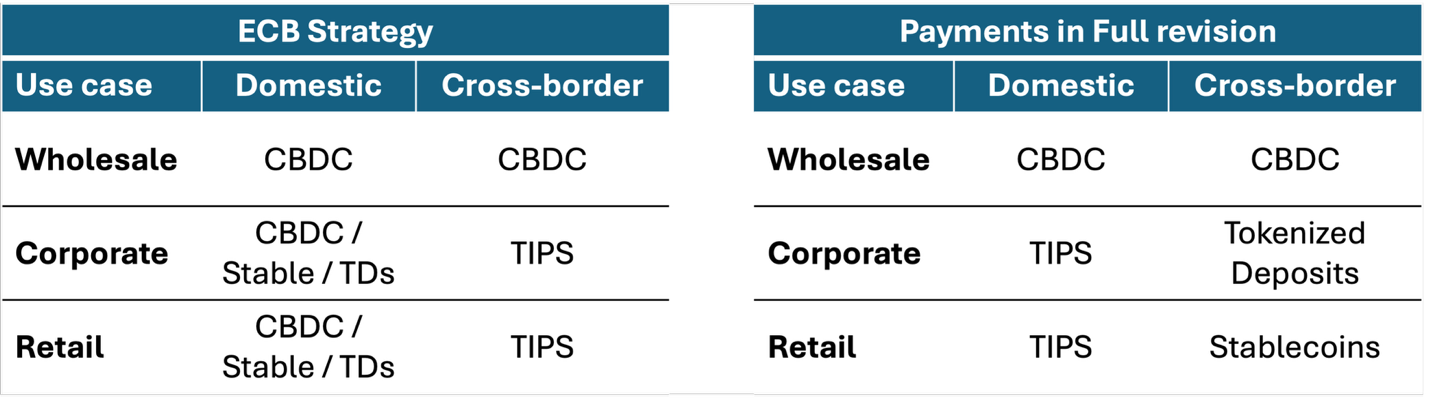
My revisions are perhaps over-simplifying the ECB strategy. In particular, they do contemplate TIPs as a domestic method. But all the strategic focus seems to be on DLTs when Instant is already ubiquitous and cheap.
Cross-border
My revisions don’t mean to imply that ECB should ban the use of Stablecoins in corporate transactions or the use of Tokenized Deposits for retail. I only mean that TDs seem best suited to Corporate use cases and Stablecoins to retail use cases. The market has already spoken in this regard and is far in advance of this ECB strategy. Digital currency for cross-border already meets most ECB goals.
My revision doesn’t entirely address the ECB’s desire to have global control over the Euro, but both Euro Stablecoins and TDs are backed by actual Euros, either fiat or government securities. No one can mint a safe Euro token without backing it with actual Euro assets. The ECB has no less control over these private sector coins than it does over other models.
Domestic
Most EU countries have invested in Instant systems, either at the EU-level or the national level. Instant provides all the stated functional benefits of digital currencies except smart contracts – for which we have not yet seen a mass market use case. Why de-prioritize this when they are already part of the way there?
Further, Instant systems meet the goal of payments nationalism better than digital currencies which are inherently borderless. ECB wants the role of settling among digital currencies, but that problem has largely been solved by tech companies.
Wholesale
This is our area of agreement. Central Bank-to-Central Bank transactions would work much better, faster, and cheaper on a blockchain than via current methods. Domestically the ECB still has to deal with national central banks and globally it deals with all major market Central Banks. Having the same blockchain system for both intra-union and external transfers makes sense to me. The challenge here is getting all the other major Central Banks to issue CBDCs and develop an interoperable protocol. To me, this should be the priority.
The ECB going blockchain-centric is significant but the strategy question worth probing is whether DLT is the right tool for the specific problem the ECB is trying to solve or whether it is partly driven by the need to appear technologically current in a policy environment where the US and China are both making aggressive digital currency moves. The autonomy dimension is probably the most honest motivation. European payment infrastructure is embarrassingly dependent on non-European rails. Visa, Mastercard, and Swift all create structural leverage points for foreign governments, and that is a geopolitical problem that a blockchain-based settlement layer could theoretically reduce. The efficiency case is harder to make without knowing the specific architecture. Permissioned blockchain systems run by central banks have consistently delivered throughput and finality numbers that are not materially better than optimized traditional database architectures. The honest question for the ECB is whether DLT is necessary for what they are building, or whether it is being used as the foundation because the political mandate requires something that looks distinct from legacy SWIFT-adjacent infrastructure.