

Chime vs. Cash App, again
Both had good earnings, but Cash App has more upside

Key insights in this post
Chime & Cash App both published good earnings last week, but they represent a tiny fraction of banking revenue and profit (even though neither is a bank)
Both companies butcher the definition of “Primary” & “Active”, which makes their customer bases seem larger than they are
“Active” includes customers with an little as 1 transaction in the period
“Primary” includes minimal direct deposit and low debit spend
Many of their primaries have a true primary at an incumbent
Chime makes one-sided comparisons with incumbents to claim its own efficiency
Its efficiency ratio is higher than incumbents when compared on an apples-to-apples basis
Its unit economics don’t account for the fact that incumbent’s customers are far more valuable, but require more services
It excludes its own marketing costs but include incumbent branch costs when those branches serve as billboards that source the bulk of originations
Grievances aside, both Neobanks likely have 4-5M true primaries, from the low-balance segment where incumbents are boxed out by the Durbin IC cap
The two companies have almost identical service sets, with a few exceptions
Chime has an unsecured credit card and a longer-term Instant Loan
Cash App has BNPL lending and a big P2P service that help source prospects
In Q2, both companies performed well
Both showed ~30% Gross Profit growth, with Cash App slightly higher
Both showed strong lending volumes
Chime had higher payments volume growth from a lower base
The biggest difference continues to be marketing approach and cost
Chime spent $164M in Q2 while Cash App no longer discloses spend but, in the same quarter last year it was ~$350M
Cash App prospects from its P2P service: It captures a customer from P2P, then cross-sells a debit card, then upsells an primary and associated loans
Chime goes for the deposit account first using loan access as its hook. Loan usage is growing at a very high rate
Cash App seems to be better at monetizing non-primaries via interchange and fees, and it has almost 10x the non-primaries
Conclusions
Low-balance accounts have tough economics, even with exempt interchange
A neobank needs low costs and efficient marketing to generate a return
While both Neobanks have efficient servicing, Cash App likely has more efficient marketing from leveraging its P2P service
Neither Neobank has advantages for higher balance customers where the bulk of industry profits lie
Introduction
I write a lot of posts on Neobanks. They do an admirable job of serving low-balance consumers, albeit with a tailwind from the Durbin amendment. On the one hand, I think they massively overstate their own relevance in financial services. As it happened, the two biggest Neos published great earnings last week and disclosed interesting data on their growth.
I thought it might be interesting to do a head-to-head comparison to the degree the data allows. I have done similar comparisons before, but this gives me an opportunity to bring those up to date.
I will first air my grievances on their puffery and then dig into how they differ and the consequences of those differences.
Grievances
Both companies butcher the definition of “Primary” and “Active” accounts, but Chime also commits egregious comparisons to banks. This all drives me nuts.
“Active” & “Primary” definitions
Both companies deploy a laughably implausible redefinition of the word “primary” as it relates to bank accounts:
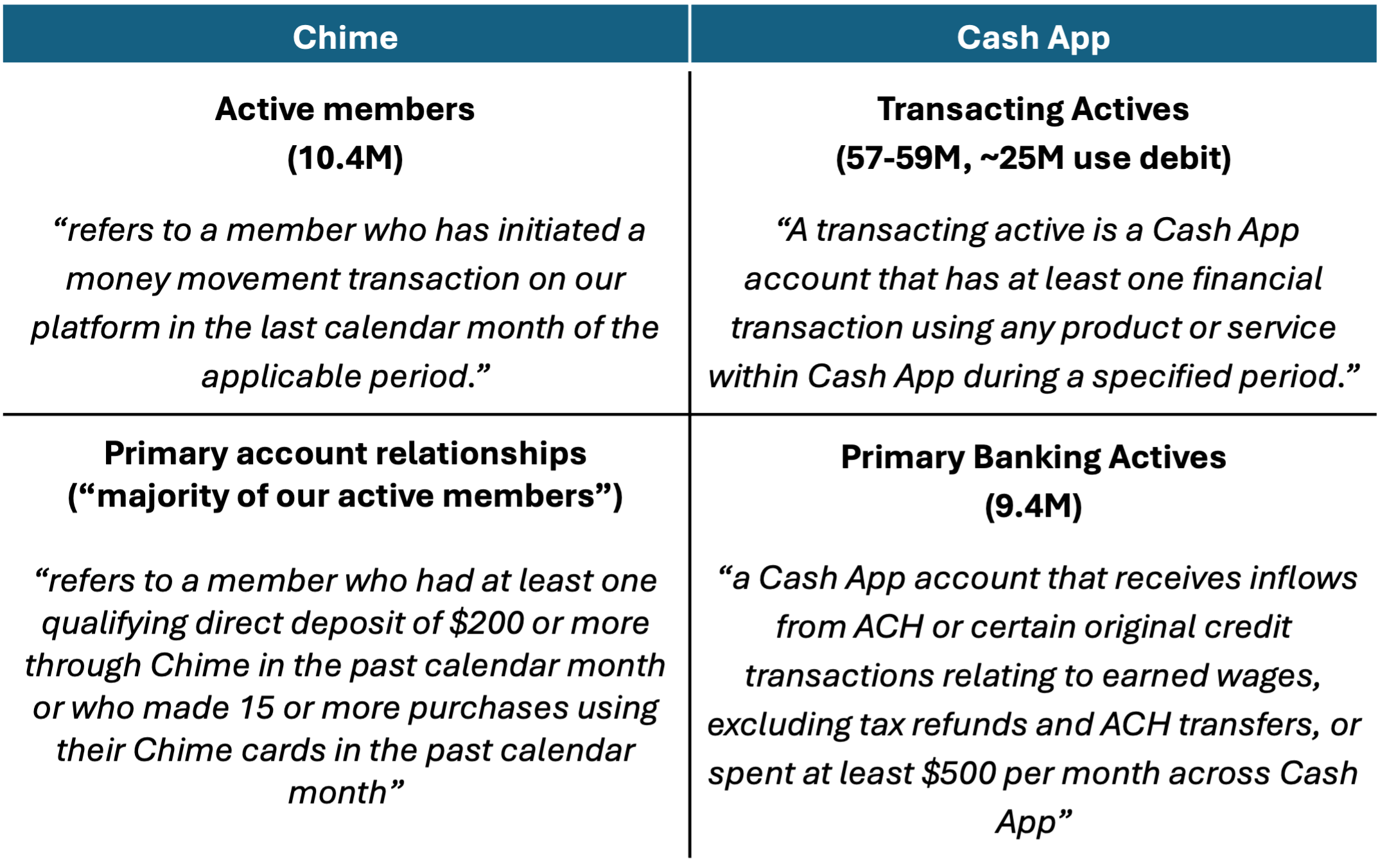
Both companies classify an account doing one transaction over the measurement period as active. The Fed estimates that an average consumer does 48 transactions per month on their checking account. That includes bill pay, card transactions, direct deposits etc. Claiming that a customer that does 1 transaction per month is “Active” seems a stretch.
Banks typically define a primary relationship as one where the consumer gets the bulk of their direct deposited wages; that would typically be 2 transactions per month; A customer doing only 1 transaction must have a true primary at another bank.
I can believe that the lower-income consumers that these companies serve do fewer bill pays per month, but they also do more transactions on their debit cards. Higher-income consumers put most of their spend on credit cards which generate one monthly bill pay in the checking statement. In contrast, lower income consumers concentrate their spend on their debit card and may do 30-40 transactions per month.
That means these companies are counting an account as “Active” if they put 2% of their transactions through that account. Implausible?
“Primary” is even worse. Note that both companies use an “or” construction between direct deposit and payment transactions. You can qualify with minimal direct deposit or you can qualify with modest spend.

Chime’s Direct Deposit minimum translates to only $2400 per year of post-tax income, while Cash App’s only requires a token amount that could be a gig-work payment. Chime’s spending threshold is under half of an active debit user’s volume while Cash App’s is about a third.
What that tells us is that a high percentage of each customer’s actives and primaries keep a true primary checking account somewhere else – likely an incumbent bank. As I showed a few weeks ago, the biggest banks are growing their deposit bases while Neobanks mostly cannibalize GPR cards. I think that holds up.
What draws consumers to these auxiliary accounts may be lending. To access Spot Me, MyPay, Instant Loans and Cash App Borrow, you must have an underlying payment account, often with direct deposit. Consumer’s are putting enough in to qualify for loans but keeping their original primary at an incumbent. That could change over time and more of the relationship could move to the Neo’s. In a sense, lending becomes a way to lower CAC. Cash App already had P2P to do that, but lending may act as a marketing channel for Chime.
Chime comparisons to bank efficiency (pages 7 & 24)
I could write whole posts on Chime’s apples-to-oranges claims, but I will limit myself here to efficiency claims. Chime claims that large banks have 3x the cost to serve than Chime has – $450 vs. $141 as of 2023. This is distorted on many levels:
Chime excludes its marketing costs but doesn’t exclude the marketing value of bank branches, which act as billboards for an incumbent bank’s services. Almost all incumbent bank customers find the bank via a convenient branch even if they rarely use it afterwards
Banks serve more affluent customers than Chime, but those customers have higher cost to serve. In the base year, Chime uses for these comparisons, Chime lost money despite a lower cost to serve because each customer generates so little revenue. For Mass Market customers, banks earn no less than $350 per year in ARPAM, for Affluent customers in can be $5K+. Spending $450 for a $5K revenue stream makes sense
The cost comparison is not apples-to-apples from a customer perspective. Banks have plenty of digital-only customers where cost to serve is likely lower than Chime:
The higher cost to serve reflects those pesky branch costs without adjusted for their marketing value. Some older segments prefer in-person but generate high revenue per account as well. Digital-only customers rarely use the branches but this analysis burdens them with the costs
Branches also serve the lucrative Small Business segment where Chime doesn’t play. Small Business naturally has higher cost to serve but also much higher revenue per account
Chime is less efficient on conventional measures. It shows Non-GAAP Opex as a % of Revenue at 59%. JPM reported a 48% efficiency ratio, the equivalent standard metric. BAC and Wells were almost identical to Chime. In other words, all-in, Chime is not more efficient despite a narrow product base and an undemanding customer base. Chime also did its calculation non-GAAP where the banks stick to GAAP.
The bottom line is that Chime barely earns a profit while big banks are highly profitable. As one example, JPM’s Retail LOB (CCB) earned $5.3B in Q2 – Chime made $28M. JPM earned almost 200x Chime, just in Retail; overall JPM earned $16.9B.
Conclusions on grievances
We should dismiss all comparisons to incumbents because the metrics used are not apples-to-apples. In terms of true primaries, each Neobank likely has 4-5M. That is still impressive as are their growth rates. Even at those levels, they might be Top 10 measured by accounts.
However, Neobanks still largely serve the low-balance segment where they have an inherent advantage from the Durbin moat. As Chime itself says, the bulk of its revenue is debit interchange. To their credit, they use some of that revenue to waive minimum balance fees. Also, to their credit they have figured out how to lend to these low-FICO populations at a profit, and usually, without high APRs. The next sections will explore the differences on how these two Neobanks get there.
Chime vs. Cash App services
Chime & Cash App have roughly the same product mix but offer different ancillary services:
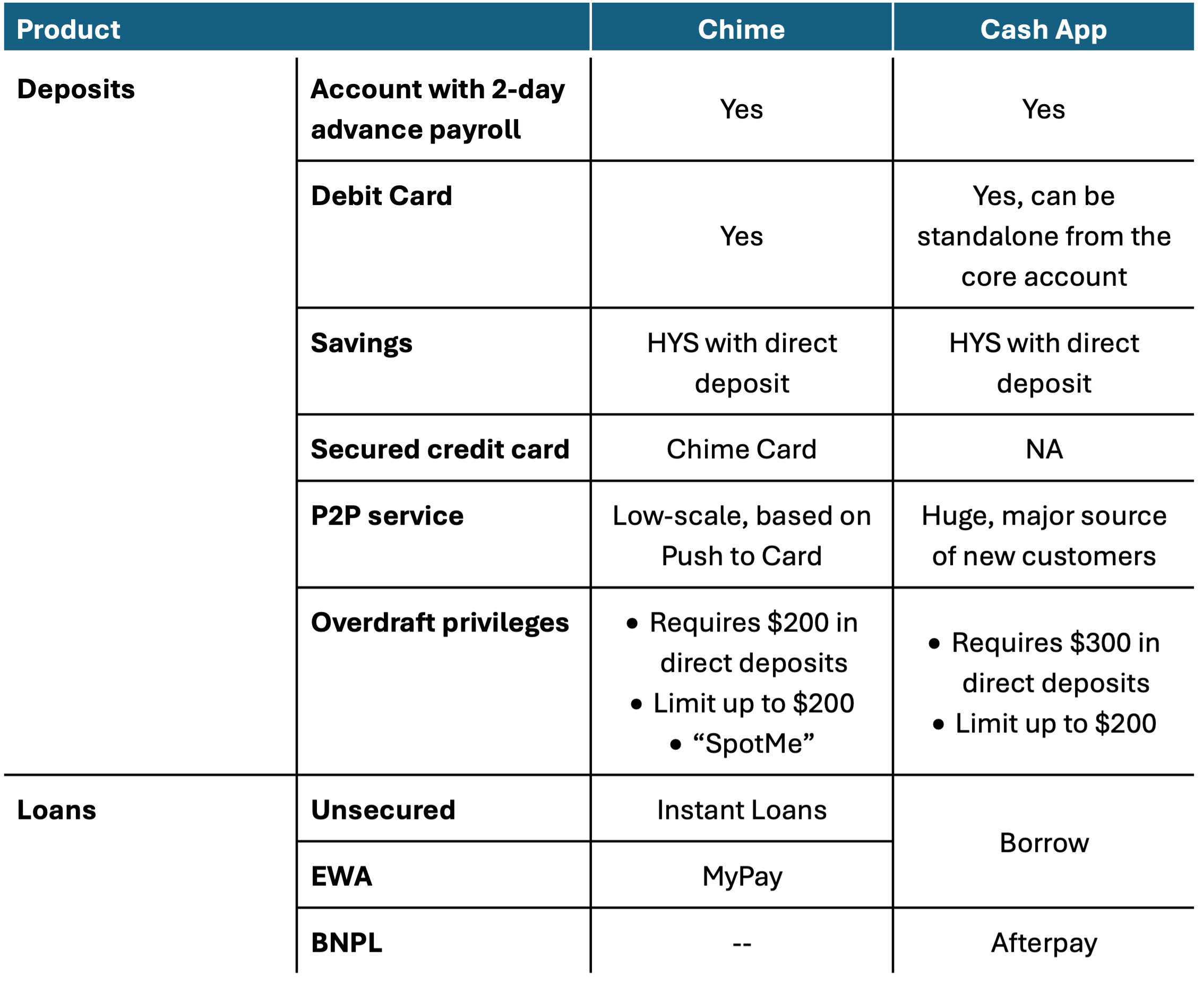
These lists and terms are almost identical. The key differences are in P2P, Credit Cards and BNPL:
Cash App has an big P2P service that serves as a low cost marketing channel to source new customers. Chime has a sub-scale P2P service built on push-to-card technology. It is likely not big enough to generate many leads. The push-to-card technology also costs more assuming standard interchange and network fees
Cash App does not have a secured credit card, but it does have the AfterPay BNPL card that allows customers borrow at the point of sale. The Chime Card is secured against the customer’s spending account. In theory, Chime Card purchases help credit scores while AfterPay purchases don’t
Chime separates it unsecured product, Instant Loans, from its EWA product MyPay. Cash App Borrow is structured like an EWA loan but isn’t explicitly marketed that way. It carries a similar fee to Chime’s Instant Loans while MyPay is free. Chime monetizes MyPay with a small, voluntary fee for instant deposit, which most users choose to pay
Cash App has the AfterPay BNPL offering that integrates with the Cash App Card or can be used independently. BNPL is typically free to the borrower since the merchant pays an MDR. Cash App does charge a fee when a Cash App Card user opts for BNPL because it only gets standard exempt interchange on those purchases
Each company also provides ancillary services such as brokerage, cypto investing and tax filing. Cash App also has a mobile service plan. Both companies offer perks and rewards. Cash App and Square also has the Neighborhoods program which give Cash App customers rewards at Square merchants. These transactions charge the merchant only 1%, so Block overall loses money after paying out rewards. The upside must be higher conversion on both sides, i.e., another reason to choose Square over Clover or Cash App over Chime.
Generally, I see few meaningful differences between these two other than Cash App’s P2P and BNPL services. Neighborhoods may make a difference eventually but today generates only $1B in spend. Any financial differences come down to how they generate revenue from all those accounts and how much it costs to get them (CAC).
Q2 performance
Block is stingy with financial and volume disclosures, but we have enough for some side-by side comparisons:
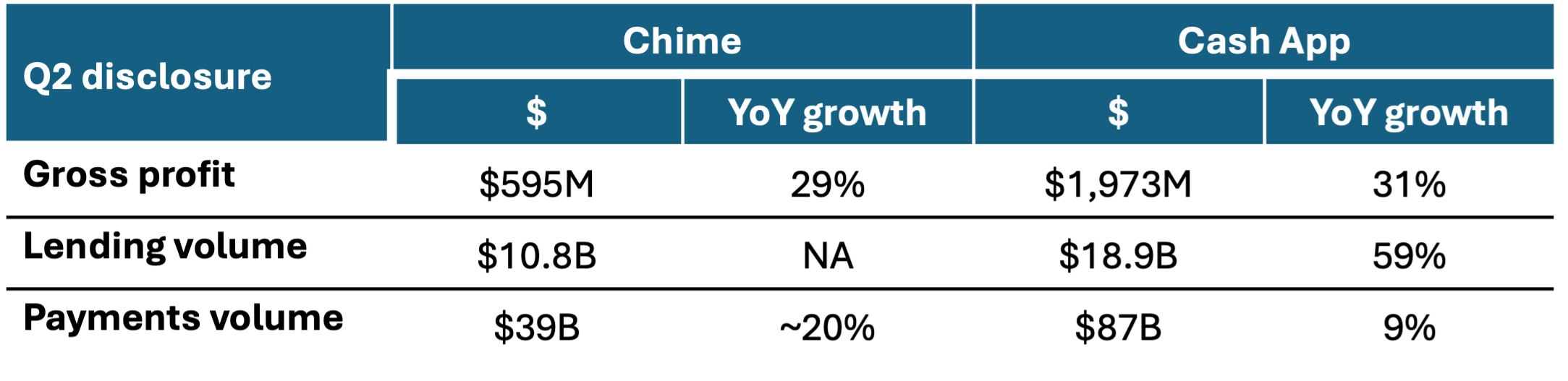
Some caveats are required for payments volume. The Cash App metric is “inflows” while the Chime metric is card spend plus fee-based transfers (OITs). Cash App has an equivalent fee to Chime’s OIT so that is apples-to-apples, but some inflows go out as a P2Ps, earning no revenue at all. We don’t know how much TPV that accounts for. All those caveats aside, Cash App grew slower on a percentage basis but added more on an aggregate basis give their higher base.
On lending volume, this is the first time Chime has disclosed volumes, so we can’t calculate a growth rate. It would be very high, but from a low base. My Pay was only introduced in 2024.
If we just focus on Gross Profit, Cash App grows just as quickly as Chime from a base 3x+ higher. Block does not disclose EBITDA at the LOB level, but overall that reached $1.2B for the quarter. The equivalent Chime figure was $102M. For Net Income, Chime was $28M while Block was $87M. Block don’t disclose the Cash App component in either of these figures, but the difference in EBITDA is stark even if the split is 50/50%.
Marketing efficiency
Neobank models depend on aggregating debit-centric consumers to build scale. Each customer contributes modest revenue, so a Neobank needs lots of them to cover fixed costs. Chime and Cash App do this differently:
Chime
Chime transparently discloses some economics:
Average Revenue Per Active Member (ARPAM) currently sits at $260 annually, or ~$22 per month. That is revenue, not transaction profit (i.e. after direct costs). Transaction profit would be $215 per member, or $18 per month (pages 17 & 20)
They claim Cumulative Transaction Profit exceeds CAC at around quarter 6 (Page 14)
ARPAM tops out at year 6 when Transaction Profit hits around $330 annually or ~$28 per month (Page 19)
If Transaction Profit breaks even versus CAC at 6 quarters, it suggests CAC is ~$325. CAC for standard checking accounts at incumbents average $300-$600 according to some sources, so Chime is at the lower end of that range, but for lower value accounts.
This data also has some “survivor bias”. Early on, Chime disclosed that account attrition was around 10% per year, which is very high relative to bank DDAs. Even with lower attrition today, roughly 20% of customers never reach that 6-quarter breakeven point. Only the most engaged members approach that $330 ceiling after the 6-year milestone.
Cash App
Cash App likely has longer tenured relationships than Chime, but with lower engagement. Customers get hooked by the free P2P service and stay on indefinitely; but that doesn’t mean they use revenue-generating services. Only about half of Cash App members take a debit card and only a third of debit card holders become “primary”.
Cash App doesn’t publish enough detail to know attrition rates, ARPAM, Transaction profit, CAC etc. They used to publish more indicators but scaled that back around a year ago.
Marketing spend
Chime discloses marketing spend while Cash App doesn’t, but we have enough to compare the two:
Chime spent $164M in Q2. That has been roughly flat for the last year
Cash App likely spends $350M+ per quarter. That is based on Q3 25, when they still published quarterly spend. That figure had grown in the prior two quarters
Assuming Cash App’s spend leveled off after Q3 25, and was still ~$350M per quarter, Cash App spends roughly twice what Chime spends. It has many more members, many more debit card holders, but roughly the same “primaries”.
It also has over three times the gross profit. My sense is that Cash App is better at monetizing its non-primaries than Chime is. A big source of that Cash App revenue is what Chime calls Outbound Instant Transfers (OITs), which transfer funds from Chime to a customer’s primary checking account. Chime only claims $1.3M of quarterly revenue for OITs, but Cash App has claimed its Instant Transfers as a major revenue source since inception. With 55M+ P2P members that can lead to a lot of revenue.
The challenge is that OITs/Instant Transfers only generate revenue when the customer has an outside DDA. The easier it is to move money from the Neobank account to those DDAs, the less opportunity to covert the Neo account to a true primary. The transfer fees are stiff, which creates an incentive to spend down those funds via debit card instead. That may be why Cash App has so many more active debit users than primaries.
Nevertheless, Cash App seem to get a better return on its marketing spend. Most customers sign on to use P2P at low CAC, about half get cross-sold a debit card and ultimately half of those are upsold a “primary” account and/or lending services.
Chime takes the harder road by going after the primary account first without a teaser product like P2P. Lending may serve as the Chime teaser product going forward as low-balance consumers highly value those low-ticket loans, but can’t get them without an underlying Chime account.
One of the astonishing things Chime disclosed this quarter was the average size of its loans: MyPay averages $85 while SpotMe is only $20. Yet their combined Q2 origination volume was $10B+. Chimes’s Instant Loans average $200, but only originated $0.3B in Q2. These loans have a high APR and stricter underwriting criteria, so upside may be limited.
Conclusion
Low-balance accounts have challenging economics. To make a profit, a provider needs low operating costs and low CAC. CAC has more challenges than Opex. Both Neobanks have low cost-to-serve via online channels. They notoriously make it hard to speak with a human.
The other way to create revenue is lots of fee income:
Interchange accounts for the bulk of revenue. Both Neos get Exempt Debit IC, but Chime cleverly created a Secured Credit Card to get even higher IC, yet with no credit risk. All this revenue comes from merchants, not consumers
Another major source is instant transfer fees. These might be called “junk” fees if an incumbent did them. Chime has these for MyPay and OIT, Cash App has these for Instant Transfers. They typically generate 90%+ margins
Lending is the growth engine for both Neobanks, but does incur credit risk. Most incumbents don’t lend to this population, even with a primary account. Some incumbents offer advances with a flat fee, similar to Cash App Borrow. Despite their low tickets, these are highly valued by customers.
But the real difference between the two Neobanks comes down to CAC.
Cash App gets a tailwind from its Viral P2P service, which feeds it prospects. They can monetize these users via Instant Transfers, while cross-selling a Cash App Card to around half, where the ARPAM goes up via Exempt IC. Then they upsell some cardholders to “Primaries”.
Chime must prospect through expensive mass marketing. Their lending activities offer an inducement to hold a primary account, but that may not result in much debit spend. Monetizing via OITs encourages the customer to keep their primary at another bank.
Of course a better way to become profitable is via higher balance accounts, but that may require bank branches and the human touch. Don’t expect that any time soon.