

Apple Pay extending its empire
Cool new features may commoditize issuers

Introduction
I am a long-time fan of Apple Pay. I use it whenever I can at the POS, in-app, and online. I find it convenient for POS, but it really shines in-app and online. It transfers my shipping data, it is truly one-click, it is secure. As a consumer, I love it.
As a banker, I always had suspicions about Apple’s long-term ambitions. One of the first posts I did was called “Disintermediation versus Intermediation”. That post was so early that less than 10% of you have read it. It is one my favorites. Apple Pay was a poster child for “Intermediation”.
Intermediation is when a non-bank inserts itself between the bank and the end-consumer by offering a better user experience. The balances and transactions stay with a bank, but the engagement shifts to the intermediary. Over time an intermediary can leverage its position with the consumer to disintermediate banks, or they can tax access as Apple Pay does with its famous 15bps fee.
Apple has largely relied on its intermediation advantage in financial services.
The Apple Card was issued by Goldman Sachs bank and now by JPM. Apple provided the brand and a channel via Apple Pay, but did not own the balances.
Apple Pay Later was originally proprietary, but Apple eventually white labelled Affirm’s offering
The Apple Savings account was on Goldman Sachs and is now on JPM
In all these, Apple collects a revenue share, sets experience standards, brands the experience and provides the primary distribution channel. But it doesn’t do any real work. When I saw Apple announced so many new Apple Pay (AP) features, I wondered whether the announcement held any hints on whether this posture was changing.
What did Apple Pay announce?
I classified the new features into two broad categories:
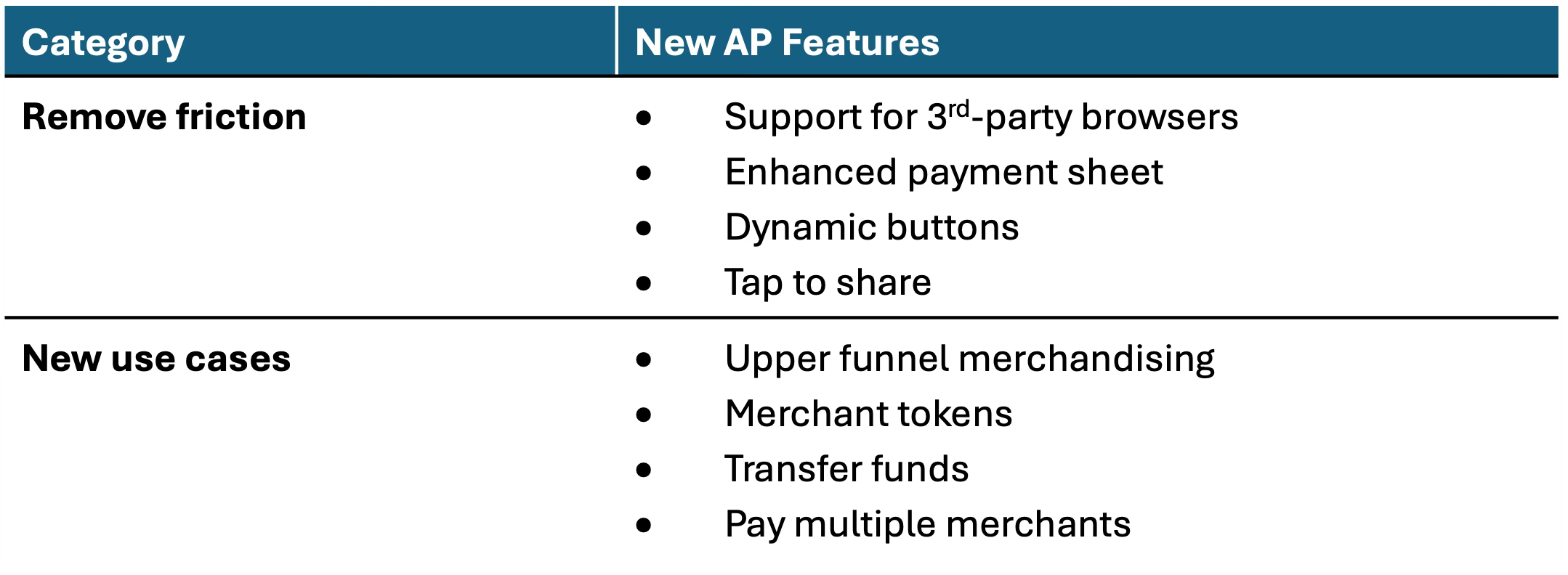
These assignments are arbitrary. For example, “Tap to Share” could have been classified as a New Use Case. The rest of this post examines the implications for each category. Spoiler alert: The new use cases are the most interesting.
Remove Friction
The support for new browsers modestly improves AP acceptance footprint. In this post, I discuss how Apple dominates in-app commerce but has more limited success in online Guest Checkout. Most merchants are not integrated. According to a recent JPM survey, Apple Pay is only accepted at 24 of the top 100 US eCommerce merchants compared to ~85 for PayPal. Notably, neither are accepted on Amazon which alone accounts for ~40%+ of eCommerce spend.
Using a browser other than Safari requires capturing a QR code to trigger Face ID or Touch ID on your Apple mobile device. This initiative expands the browsers that support the QR model beyond Chrome and Firefox.
For IOS, less than 10% use an unsupported browser
For Macs, Chrome and Safari already support AP and have 70%-90% share
This feature provides modest expansion into the long tail of browsers. It may be aimed more at merchants that only want payment methods that support most of their customer base.
The remaining “reduce friction” features are classic Apple UX improvements:
Enhanced payments sheet. Allows the user to change cards on the payment screen. Importantly, this only seems to work in-app or online, not at the POS. This also makes more data available, including “rewards, balances, etc.” This requires issuer integrations and captures engagement that might otherwise go to issuer apps
Dynamic buttons. Apple highlights a use case showing card art right next to the AP logo. It helps to see what card is queued up to pay for in-app experiences
Tap to share. This POS feature requires the consumer to physically tap a merchant’s IOS device. Most merchant POS devices are not IOS, so this may only help informal merchants like farmers’ markets and food trucks
I wonder whether these features will start with Chase cards now that Chase is Apple’s issuer. It would give the Apple Card and other Chase cards a temporary advantage if they integrate for launch while others integrate later. Affluent cardholders are overwhelmingly IOS-centric, so affluent-segment issuers like Amex, Chase and Capital One will all want to play.
